

Introduction
Contemporary organizations are experiencing new challenges in their areas of activity, and the response to many of these challenges is innovation (Bojewska, 2024). Innovation can take the form of implementing a modernized process, method, or practical solutions within an enterprise, aimed at achieving specific economic and social benefits (Myjak, 2023). Innovation is among the most important factors in the competitiveness of countries in the global economy and is the most important condition for their growth and development. The crucial role of innovation as a factor in stable and sustainable economic growth is widely recognized (Sołek-Borowska, 2018). Innovation plays a significant role in various forms of economic activity and the effective functioning of organizations in various business fields (Kogabayev, Maziliauskas, 2017). It is of significant importance to every organization and serves as its driving force. On the one hand, they support the development and survival of the organization, but on the other hand, it is a complex and risky process (Ramakrishnan, 2020).
Innovation is such a broad and ambiguous concept that various definitions can be expected. A key feature of all definitions is that innovation cannot be narrowed down to concepts such as invention or new product (Michnik, 2013). Innovation encompasses not only the development of new products or the commercialization of inventions but also changes in human behavior and the methods of implementing specific activities in society (Kochetkov, 2023). The essence of innovation is the combination of multiple events and activities leading to a set goal (Michnik, 2013). Innovation is associated with key elements such as value creation, outcome, process, degree of novelty, and the implementation of the innovation itself (Duha, 2022). When considering the issue of innovation, it should be noted that it is very broad. To understand it more deeply, it is necessary to emphasize that innovation assumes novelty and uniqueness, requires value creation, and is not accidental. Innovation is more than creativity, it is a process, and knowledge is a key resource in this process (Mierzejewska, 2010).
The growing popularity of innovation is resulting in a growing number of empirical studies. A review of the literature on the subject reveals the diversity of approaches to innovation by individual authors. This publication explores the perception of innovation. The theoretical section discusses what the author considers to be rather distinctive terms describing innovation. The research section focuses on presenting various terms describing innovation from the perspective of final-year students at a public university.
Perception of Innovation – A Review of the Literature
Innovation can be associated not only with new services or the creation of new products, but also with the improvement of existing ones (Taylor, 2017). Furthermore, innovations can be classified based on whether they introduce something new or improve an existing aspect of the organization (character). The resources or means used to drive and support innovation can be identified in relation to the balance between technology, ideas, inventions, creativity, and the market (Baregheh et al., 2009). A review of the literature on the subject shows that innovation is perceived differently.This is evidenced by the significant number of definitions of innovation, including the following:- Innovation is defined as a process encompassing all activities related to the creation of an idea, the development of an invention, and ultimately the implementation of a new or significantly improved product, service, process, or organization (Pomykalski, 2001);
- Innovation is a tool that creates new opportunities for a company in the face of implemented changes (Bojewska, 2024);
- Innovation requires the integration of goals, tasks, and functions, research and development, design, production, as well as entities collaborating in implementing individual phases of innovation (Kozioł-Nadolna, 2013).
Enterprises that use appropriate tools for innovation projects draw heavily on external resources, develop rules of conduct, rational remuneration systems, and use a common language of innovation, encouraging employees to take prudent risks on the path to innovation-based growth (Anthony et al., 2014).
Figure 1 presents various contexts influencing innovation, demonstrating their complexity, taking into account both external and internal conditions.
Figure 1
Innovation as a result of confrontation with the organizational context Source: Francik, 2003.
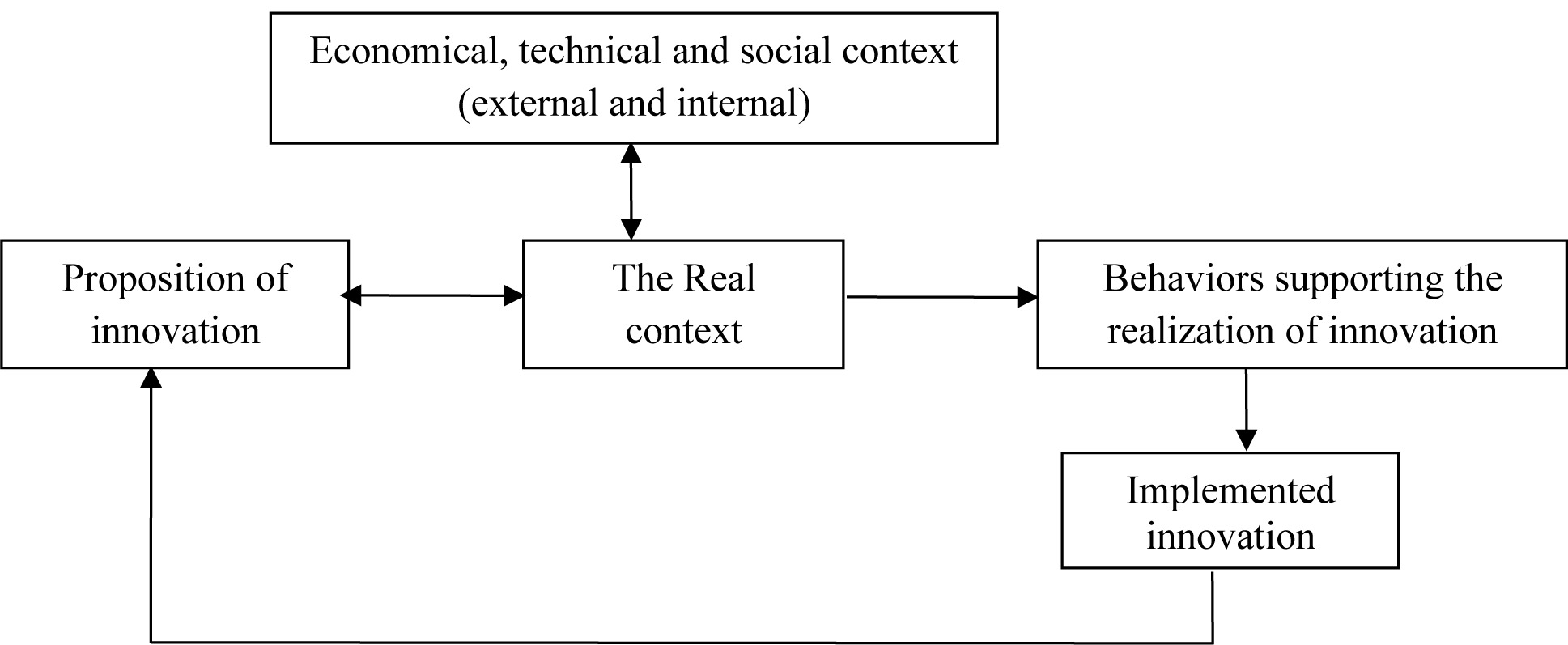
The contemporary approach to innovation takes into account both the complexity and dynamics of innovation processes and the existence of numerous feedback loops between individual stages of the process (Pomykalski, 2007). Every innovation requires adaptation of the social system, which may involve recognizing and overcoming resistance to change and persuading employees to accept the innovation. This involves issues of remuneration, authority, mobilization of skills, and employee management to match employee expectations to changes and determine the benefits they bring (Francik, 2003). Recent years have seen significant development in innovative employee management practices (Wysocka, 2025). Employee management significantly influences the innovative situation, i.e., all stages of the innovation creation and implementation process, and also determines whether this situation will occur and, if it does, how it will develop. The method of employee management determines the attitudes and relationships between employees: From overt hostility, through competition or coexistence, to cooperation. Therefore, it is crucial to appropriately recruit, motivate, and activate organizational participants in their pursuit of innovation (Francik, 2003). Innovation-related activities can sometimes encounter numerous barriers that completely prevent or slow down innovative actions. The desire and ideas to implement change alone may prove insufficient (Zymonik, 2015). Behaviors that support innovation should also dominate the actions of those responsible for the effective operation of an enterprise, and one path to success is combining employee ingenuity with innovation (Jankowiak, 2007).
In summary, it is important to distinguish between the process, outcome, and context of innovation. The process is a sequence of specific actions leading to the introduction of innovation. The outcome is the actual effect of implementing innovation. The context of innovation, on the other hand, refers to the conditions in which innovation is created and implemented.
Research Methodology
The research on this topic began in late 2024 and was completed in early 2025. The research was quantitative in nature. A survey technique was used, using a proprietary questionnaire distributed electronically. The choice of research tool was based on the adopted research conceptualization. The research tool consisted of two parts. The first, substantive, involved obtaining information from respondents regarding their perception of innovation. The second, metrical, survey was aimed at obtaining information characterizing the respondents, including:
- gender: Women (73.3%) and Men (26.7%);
- field of study: Economics (54.3%), Management (24.8%), e-Government (5.7%), Business Economics and Finance (15.2%);
- form of study: Full-time (59.0%) and Part-time (41.0%).
A total of 105 respondents (students) were surveyed. During the learning process, students have the opportunity to acquire the latest, most up-to-date knowledge about innovation. They can analyze and evaluate innovative solutions that they often use in their everyday lives. This allows them to understand the essence of innovation. Their insights, as future employees of companies, can be considered a reliable indicator of a better understanding of innovation.
The literature on the subject contains various research findings on innovation, but there is a certain research gap. In fact, there is a lack of research showing how students in their final-years of study, future employees of companies, perceive innovation. The choice of final-year students as a research group seems justified and appropriate, although it concerned only one public university and one faculty. The research sample was selected based on the adopted research assumptions.
The analysis of the survey results includes statistics in the form of the number and percentage of responses, the mean, and the standard deviation. Student opinions formed the basis for the analysis, and the survey results formed the basis for formulating the author’s conclusions. Two research theses were established:
T1: Innovations require the integration of goals, tasks, functions, and collaborating entities;
T2: Every innovation requires the adaptation of the social system (organization’s participants).
The results presented in this work refer to a portion (not the entirety) of the survey questionnaire, prepared for a purposefully selected sample. The research results are therefore a fragment of the author’s broader empirical research. A five-point Likert scale was used, as a well-known and commonly used question structure in survey questionnaires, to assess students’ opinions regarding innovation. The analyzed issues were assessed on a scale described verbally (where 1 means „strongly disagree” and 5 means „strongly agree”).
Research Results
The aim of the study was to determine the opinions of university students (students in their final year of studies) regarding their perception of innovation in relation to terms describing innovation. A questionnaire containing terms related to innovation was developed for the study, with options to choose from. Respondents were asked to respond to individual statements and indicate their own choices. A summary of the data is presented in table 1.
Table 1
Perceptions of innovation
The research results presented in table 1 showed that the highest combined percentage of responses of the „I tend to agree” and “I strongly agree” (86.7%) related to the statement that innovation requires the integration various elements. One percentage point less respondents supported the view that innovation includes novelty and uniqueness and combines many events and actions leading to a specific goal. Slightly fewer (in total 84.8%) indicated that the desire and ideas to innovate alone may prove insufficient. 83.8% believed that knowledge is a key resource in innovation. Exactly 80% of respondents recognized the superiority of innovation over creativity, and almost the same percentage indicated that employee management influences the innovation process. 78.1% stated that innovation requires the creation of value that brings real benefits to both the organization and its employees. The option indicating that every innovation requires adaptation by the organization’s participants was chosen by 77.1%. Significantly fewer respondents (in total 56.2%) expressed the view that innovation is not an accident, but a deliberate and intentional process.
In all responses, the average indicates that respondents chose answer 4 on average. The standard deviation can be considered relatively low, i.e., the responses did not differ from 4 by more than one point on the scale (compliance on the scale). The dystrybutor of responses shows that these deviations most often meant choosing 5 on the scale.
The results presented in table 1 supported thesis no. 1, which stated: Innovation requires the integration of goals, tasks, functions, and collaborating entities. A total of 86.7% of respondents confirmed this. At the same time, the distribution of responses is characterized by a relatively low percentage of people “having no opinion” – 9.5% and people who gave a negative answer. Thus, thesis no. 1 has been positively verified.
This cannot be said for Thesis 2, which assumed the need for innovation to be adapted by the social system. Other response options regarding innovation were ranked higher by respondents. Respondents placed the statement about the adaptability of innovation by the social system in second-to-last position. In the case of thesis T2, the results were not as clear-cut. In fact, 77,1% of respondents in total confirmed that every innovation requires adaptation of the social system. However, compared to the other statements subject to examination, this is one of the lowest results obtained. Moreover, in this case, 5.7% of respondents stated that they “rather disagree” with such a statement. Additionally, 17.1% also stated that they had “no opinion” on this issue. Therefore, in the light of the analysis of the entire results, it is not possible to unequivocally and positively verify thesis T2.
Discussion
The review of innovation research showed that this issue is analyzed at various levels and, therefore, perceived differently in theory and practice.
The perception of innovation and its role in the life of societies is changing with socioeconomic development. Social development is currently strongly intertwined and dependent on the ability to promote and utilize innovation in all areas of social life. This is an important argument for researching innovation issues to find appropriate ways to implement and utilize innovations in current conditions, for the economic development and well-being of society as a whole (Albu, 2017). Innovation-based social and economic development leads to the wealth of individual countries (Francik, Kosała, 2010). For example, the Entrepreneurship Barometer 2025 report shows that Polish entrepreneurs were most likely to implement innovations to change or improve their products and services. They focused their efforts on expanding their offerings, acquiring new customers, and improving their competitive position (EY, 2025). Research conducted by the Polish Agency for Enterprise Development showed that 91.7% of respondents felt that innovation activities contributed to the overall development of their companies (PARP, 2023). The highest percentage of innovation-active entities was recorded among large enterprises, employing 250 or more people (GUS, 2023). It has been shown that large enterprises increasingly use their size to strengthen their innovation potential (Ringel et al., 2020). Referring to the information provided, it should be added that large companies, compared to small ones, are more active in terms of innovation. Moreover, they cooperate to a greater extent and allocate more financial resources to research and development.
The latest report by the Małopolska Observatory of Regional Development shows that over 80% of the 1,200 surveyed business entities undertake innovative activities, and one percent more plan to implement at least one innovation within two years. At the same time, 33% of entities implementing innovation activities use external support, including the services of universities (MORR, 2021). Other studies indicate that products, processes, and organizational and marketing methods do not have to be new to the market in which the enterprise operates, but they must be new to the enterprise itself. Furthermore, they do not have to be developed by the enterprise itself, but can be developed by another entity, such as a scientific and research institute, research and development center, or university (GUS, 2014). It is also noted that in Poland, the conditions in which innovation-oriented enterprises operate still differ significantly from those faced by enterprises in the most developed European Union countries (Baczko, 2018).
Conclusions
Research on the perception of innovation is not a new phenomenon, but undoubtedly one that continues to be explored by both theoreticians and practitioners, as evidenced by the number of publications on the topic and which significantly influenced the author’s choice of research area. The empirical material collected during the research process allowed us to determine how academic students in their final years of study perceive innovation based on the categories that express it. Analyses showed that the highest percentage of responses concerned three statements related to innovation: that innovation: assumes novelty and uniqueness, combines multiple events and actions leading to a set goal, and requires the integration of goals, tasks, functions, and collaborating entities. Relatively few respondents stated that every innovation requires adaptation by the organization’s participants.
Research limitations should be noted here. The research results presented in this publication should be approached with caution due to the fact that the study was conducted among only 105 respondents, studying exclusively at a single faculty. The small sample and non-random selection do not allow for generalization of the results, but they may inspire further, in-depth empirical research, and their findings may enrich knowledge on the subject matter. This research should be expanded to include other elements related to innovation.
The results of the presented research may be useful for practitioners. The use of existing knowledge about innovation can translate into the effectiveness of innovative activities.