

Inroduction
For the majority of the 20th century, the field of academic study largely ignored the importance of moral character. Character strengths are defined as personality traits that are deemed integral to the development of moral character. As Baumrind (1998) asserts, the aspiration of goodness necessitates a virtuous character, while the execution of goodness demands proficiency. The cultivation of character strength has been demonstrated to facilitate the achievement of significant life objectives by young individuals. In the absence of character strengths, individuals may experience a deficiency in motivation to engage in appropriate behaviors. Significant aspects of both individual and societal well-being have been identified as being associated with character strengths.
The outcomes predicted by diverse strengths are also diverse (Park, Peterson, 2009). According to Gillham (2011), “Character strengths are influenced by family, community, societal, and other contextual factors. At least in theory, character strengths are malleable; they can be taught and acquired through practice”. The significance of character strengths lies in their intrinsic value, which has been demonstrated to enhance an individual’s well-being and satisfaction. Given that VIA character strengths are defined psychologically as life satisfaction with well-being, it is not surprising that they are generally associated with life satisfaction (Peterson et al., 2007). According to Peterson and Seligman (2004), the Values Action Model is the most systematic technique for researching virtues and character strengths in psychology. This paradigm comprises 24 strengths, which are embedded in six virtues that are valued in many cultures. The six universal virtues – wisdom and knowledge, courage, humanity, justice, temperance, and transcendence – have been employed to characterize virtues based on theoretical beliefs (Ruch, Proyer, 2015).
The majority of VIA’s character strengths, such as justice, humanity, and transcendence, have been associated with well-being (Chung, 2023). There is a plethora of viewpoints on how to measure a good concept of well-being (Huta, Waterman, 2014). The “Seligman’s Well-Being Theory” is a contemporary model that incorporates both hedonic and eudaimonic elements. It is posited that the term PERMA is an acronym for positive emotions, engagement, relationships, meaning, and accomplishment. These five aspects of well-being are believed to be sought for personal benefit (Seligman, 2011). Butler and Kern (2016) developed a questionnaire “The PERMA Profiler Scale” for assessing the PERMA dimensions, thereby demonstrating that all dimensions are highly connected to other measures of well-being. The PERMA Profiler model is predicated on two perspectives of well-being: hedonism and eudaimonism (Kern, 2022). The PERMA Profiler is a comprehensive framework for understanding human flourishing because it incorporates both the hedonic (positive emotions, happiness, health, negative emotions, loneliness) and eudaimonic (engagement, relationships, meaning, accomplishment, health) components of well-being (Seligman, 2011; Huta, Waterman, 2014; Butler, Kern, 2016).
Review of Literature
The presence of character strengths and resilience has been demonstrated to have a positive effect on the well-being of adolescents (Pandey, Singh, 2024). Joseph (2024) examined the relationship between character strength virtues, psychological resilience, and eudemonic well-being. The results of the study indicated that character strength virtues, psychological resilience, age, sex, the highest level of qualification, current employment status, and relationship status were associated with eudemonic well-being. In his study, Fine (2024) identified signature strengths that facilitate well-being, satisfaction, and psychological flourishing. Verma and Manju (2021) study also identified a correlation between personality traits, family environment, and well-being. The findings indicated a positive correlation between personality traits, familial environment, and well-being. Vohra and Pandey’s (2020) study identified twelve distinct character strengths, including gratitude, judgment, hope, teamwork, humility, social intelligence, leadership, curiosity, forgiveness, self-regulation, honesty, and prudence. These character strengths were found to be associated with enhanced mental health and increased sociability. A positive and significant relationship was identified between efficiency, interpersonal relationships, and overall subjective well-being. Blanchard et al. (2020) discovered that the perceived value of one’s signature strengths by their job or school is a strong predictor of well-being. Martínez-Martí et al. (2020) evaluated 348 individuals during the course of the pandemic and discovered that character strengths initially correlated with life satisfaction and positive affect, but later correlated with negative affect and poor mental health. The study’s findings indicate that a combination of grit, internal strengths, and interpersonal skills can effectively mitigate suffering, with grit demonstrating a strong correlation with positive emotional responses.
Lee (2019) discovered that optimal use of character strengths was connected with greater physical and mental health, as well as positive behavior, whereas low or excessive use was associated with bad mental health, abnormal behavior, and unpleasant emotion. Tehranchi et al. (2018) discovered that seven significant character strengths – emotional intelligence, critical thinking, hope, forgiveness, zest, and gratitude – exhibit a protective effect against depression. The study found that emotional intelligence enhanced emotional awareness, while critical thinking diminished the necessity for acceptance and perfectionism in managing depression. Kaufman’s (2015) study revealed a positive correlation between character strengths and well-being. Hope, gratitude, and love were identified as the strongest associations, with gratitude emerging as the strongest predictor among individuals. In their seminal study, Proctor et al. (2010) identified humor, love, kindness, open-mindedness, and social intelligence as the predominant strengths. These findings suggest that zest and hope serve as significant predictors of subjective well-being.
The findings of the aforementioned research studies suggest that character strengths play a pivotal role in enhancing the well-being of adolescents.
Rationale for the current research and research questions
The character strengths examined in this study adhere to the VIA classification system proposed by Peterson and Seligman (2004). A growing body of research has indicated that these traits are significant contributors to children’s well-being across diverse cultural contexts (Smith et al., 2022; Carlo et al., 2022). These strengths have been demonstrated to serve as a protective barrier against risky behaviors and are highly regarded on a global scale (Dahlsgaard et al., 2005). These practices have been shown to promote authenticity, development, health, and life satisfaction (Niemiec, Wedding, 2013). The objective of the present study is to:
The objective of this study is to examine the relationship between character strengths and well-being.
The objective of this study is to identify the factors that contribute to the well-being of adolescents.
Based on the extensive literature assessment, the following hypotheses have been suggested:
Methodology
Research Design and Participants
In the present study, purposive sampling was employed to include 200 students (100 boys and 100 girls) from classes IX to XII, aged 14-18 years, as a unit sample.
Questionnaire
The Hindi version of VIA Youth-96 (Park, Peterson, 2005) was utilized to assess character strengths in students aged 14-18. The inventory encompasses 96 items, which are distributed across 24 strengths and 6 virtues, with 4 items allocated to each strength. The internal consistency of the VIA Youth Scale (α = .78) was satisfactory. Participants were instructed to respond using a 5-point Likert scale ranging from 1 (very little) to 5 (very much).
The PERMA Profiler scale (Butler, Kern, 2016) was utilized to assess students’ well-being. The PERMA Profiler also demonstrated adequate reliability, with alpha coefficients ranging from .72 to .90. The scale, which is suitable for individuals aged 10 and above, encompasses 23 items and is measured on an 11-point scale ranging from 0 to 10. Scores of higher magnitude are indicative of greater well-being.
Procedure
Purposive sampling was employed for the collection of data. The collection of data was executed through the utilization of an offline medium. Prior to the completion of the questionnaires, informed consent was obtained from the subjects. All subjects completed a set of questionnaires. The collected data was then subjected to rigorous analysis using SPSS 16, a software program designed for statistical analysis. The analysis employed both Pearson’s correlation coefficient and regression analysis methods to assess the relationship between the variables of interest.
Results
The data were then subjected to analysis using Pearson’s correlation coefficient and stepwise regression, in order to meet the objectives of the research study.
Correlation Analysis
The initial objective of the research was to ascertain the relationship between character strengths and the well-being dimensions of adolescents. The Pearson product moment method was employed in the analysis.
As illustrated in Table 1, there is a clear indication of a substantial correlation between character strengths and adolescents’ well-being. During the developmental stage of adolescence, there is a positive correlation between creativity and positive emotions. Consequently, individuals with high levels of creativity are more prone to experience positive emotions.
Table 1
Outcome based on Correlation Analysis
[i] V-Variable: 1-Creativity, 2-Curiosity, 3-Judgment, 4-Love of learning, 5-Perspective, 6-Bravery, 7- Persistence, 8-Honesty, 9-Zest, 10-Love, 11-Kindness, 12-Social intelligence, 13-Citizenship, 14-Fairness, 15-Leadership, 16-Forgiveness, 17-Humility, 18-Prudence, 19-Self-Regulation, 20-Appreciation of Beauty, 21-Gratitude, 22-Hope, 23-Humor, 24-Spirituality, and 25-Character Strength. P-Positive Emotion, E-Engagement, R-Relationship, M-Meaning, A-Accomplishment, HP-Happiness, OW-Overall Wellbeing, N-Negative Emotion, H-Health L-Loneliness.
In adolescents, a positive and significant correlation was identified between the strength of curiosity and positive emotions, accomplishment, health, meaning, relationships, and happiness. Conversely, a negative correlation was identified between curiosity and loneliness as well as negative emotions. These findings collectively reflect the overall well-being and life satisfaction of adolescents.
The present study sought to ascertain the relationship between adolescent judgment strength and various psychological factors. The findings revealed a positive significant correlation between adolescent judgment strength and positive emotions, accomplishment, meaning, and relationships. In contrast, a negative significant correlation was observed between adolescent judgment strength and negative emotions, as well as loneliness. This suggests that individuals who possess the judgment trait may be more likely to achieve their objectives, lead meaningful lives, cultivate robust relationships, and experience reduced feelings of loneliness.
The study’s findings indicated a positive significant correlation between the adolescents’ love of learning trait and positive emotions, accomplishment, meaning, relationships, and happiness. In contrast, a negative significant correlation was observed between the trait and negative emotions. Individuals who possess a propensity for learning often demonstrate a proclivity for achieving objectives, cultivating robust interpersonal connections, experiencing elevated moods, and maintaining a predominance of positive emotions.
The present study sought to ascertain the relationship between adolescents’ perspective strength and their emotional well-being. The findings revealed a positive significant correlation between perspective strength and positive emotions, accomplishment, meaning, and happiness. In contrast, a negative significant correlation was identified between perspective strength and negative emotions, as well as loneliness. Individuals who maintain a broad viewpoint have been shown to experience increased happiness, decreased feelings of loneliness, and a reduction in negative emotions. Furthermore, these individuals have been observed to achieve their goals and lead more fulfilling lives.
In the adolescent population, bravery strength exhibited a positive significant correlation with positive emotions, meaning, and accomplishment. Conversely, it demonstrated a negative significant correlation with loneliness. It has been demonstrated that students who exhibit bravery traits tend to demonstrate higher levels of academic achievement, lead more fulfilling lives, experience increased positive emotions, and report lower levels of loneliness.
In adolescents, persistence strength exhibited a positive significant correlation with positive emotions, relationships, meaning, and accomplishment, and a negative significant correlation with negative emotions. Individuals who demonstrate persistence have been shown to achieve more, establish robust relationships, experience a greater prevalence of positive emotions, and a reduction in negative emotions.
In the adolescent population, a positive significant correlation was identified between honesty strength and positive emotions, as well as a negative significant correlation with negative emotions. This finding suggests that individuals who are characterized by honesty experience a greater prevalence of positive emotions and a reduced incidence of negative emotions.
The findings of this study indicated a significant correlation between zest strength and all dimensions of adolescents’ well-being. This phenomenon is indicative of an elevated capacity to establish and maintain social connections, pursue objectives, and attain a sense of personal fulfillment.
Adolescents who exhibit high levels of love strength demonstrate a greater capacity for accomplishment, positive emotions, engagement, relationships, meaning, accomplishment, happiness, and health. In addition, they exhibit a reduced tendency towards loneliness and negative emotions. This finding suggests that individuals who have experienced such a transition may be more likely to report a sense of fulfillment in their lives, characterized by robust social connections and a general state of emotional well-being.
A positive and significant correlation was identified between adolescents’ kindness and strength on the one hand, and their sense of meaning and accomplishment on the other. Compassionate individuals have been shown to be more likely to achieve their goals and follow a meaningful, purposeful life path.
In adolescents, higher social intelligence strength was associated with positive emotions, relationships, meaning, and accomplishment. In contrast, lower social intelligence strength was associated with negative emotions. Individuals who possess a high degree of social intelligence have been shown to achieve their objectives, lead fulfilling lives, and experience a greater prevalence of positive emotions compared to negative ones.
In adolescents, citizenship strength exhibited a positive correlation with positive emotions, relationships, meaning, accomplishment, happiness, and health; and a negative significant correlation with negative emotions and loneliness. Individuals who exhibit citizenship traits have been shown to achieve goals, establish robust relationships, and lead lives characterized by health, happiness, and fulfillment.
In the developmental stage of adolescence, positive emotions, the significance of relationships, and the attainment of accomplishments have been found to be positively correlated with perceptions of fairness. Individuals who possess a pronounced sense of fairness tend to demonstrate a higher propensity for achieving their objectives, experience elevated levels of contentment, lead purposeful lives, and cultivate positive relationships.
In the adolescent population, leadership strength demonstrated a positive significant correlation with positive emotions, engagement, relationships, meaning, accomplishment, and happiness. Conversely, leadership strength exhibited a negative significant correlation with negative emotions and loneliness. Individuals who exhibit leadership qualities have been shown to accomplish objectives, cultivate robust relationships, pursue a fulfilling life, maintain physical activity, maintain a positive outlook, and evade the perils of loneliness and negativity.
The present study sought to ascertain the relationship between the forgiveness trait exhibited by adolescents and the subsequent impact on their emotional well-being, as well as on their sense of purpose and achievement. The findings revealed a positive significant correlation between the forgiveness trait and positive emotions, meaning, and accomplishment. In contrast, a negative significant correlation was observed between the forgiveness trait and negative emotions, as well as feelings of loneliness. Individuals who are capable of forgiveness have been shown to achieve their objectives, lead meaningful lives, experience positive emotions, and report reduced feelings of loneliness or other negative effects.
A positive and significant correlation was identified between humility, strength, and accomplishment in adolescence. Consequently, individuals who exhibit high levels of humility are more likely to demonstrate high achievement skills.
In the developmental stage of adolescence, a positive and significant correlation between prudence strength and positive emotions, meaning, and accomplishment has been demonstrated. It is evident that individuals who exercise prudence attain greater accomplishments, experience elevated levels of positive emotions, and pursue a life path that is both worthwhile and valuable.
The present study sought to ascertain the relationship between adolescents’ self-regulation strength and their well-being. The findings indicated a positive significant correlation between self-regulation strength and positive emotions, relationships, meaning, accomplishment, happiness, and health. In contrast, a negative correlation was observed between self-regulation strength and negative emotions, as well as loneliness. Individuals who engage in self-regulation have been shown to achieve goals, maintain well-being, establish robust interpersonal connections, experience positive emotions, and evade the perils of loneliness and negativity.
A positive significant correlation was identified between adolescents’ appreciation of beauty and strength on the one hand, and positive emotions, relationships, meaning, and accomplishment on the other. Individuals who value aesthetic qualities tend to accomplish objectives, experience contentment, pursue meaningful endeavors, and cultivate beneficial connections.
In the adolescent population, gratitude strength demonstrated a positive significant correlation with positive emotions, engagement, relationship meaning, and accomplishment. Conversely, gratitude strength exhibited a negative significant correlation with negative emotions and loneliness. Conversely, individuals who maintain a sense of gratitude have been shown to be more likely to achieve their goals, cultivate robust relationships, maintain physical activity, experience positive emotions, and report lower levels of loneliness and negativity.
Adolescents have demonstrated a correlation between hope and positive emotions, relationships, meaning, accomplishment, and happiness. In contrast, a negative significant correlation has been observed between hope and negative emotions, as well as loneliness. The pursuit of goals, the cultivation of a meaningful existence, the formation of positive relationships, and the experience of positive emotions are all part of this process. García-Castro (2022) discovered that Hope influenced the relationship between perceived stress, life satisfaction, and reported benefits of caregiving.
The present study sought to investigate the relationship between humor strength in adolescents and various psychological and relational factors. The hypothesis was that there would be a negative correlation between adolescent humor strength and loneliness, and a positive correlation between humor strength and positive emotions, engagement, relationships, meaning, accomplishment, and happiness. Individuals who exhibit humorous tendencies have been observed to achieve more, fully engage with their surroundings, live in a meaningful way, experience contentment, cultivate relationships, and feel less lonely. Bowles et al. (2025) discovered that a positive humor style was significantly connected with individual well-being.
In the adolescent population, spirituality strength demonstrated a positive significant correlation with positive emotions, relationships, meaning, accomplishment, happiness, and health. Conversely, spirituality strength exhibited a negative significant correlation with loneliness. Individuals who possess a strong spiritual inclination have been observed to demonstrate superior levels of accomplishment, maintain optimal health, experience a greater sense of contentment, cultivate robust interpersonal connections, and exhibit a greater prevalence of positive emotional states, along with a diminished perception of loneliness. Bowles et al. (2025) discovered that historian spirituality and religious practices had a substantial impact on the family contentment of service members.
Preliminary findings from the present study suggest a positive correlation between character strengths and adolescents’ overall well-being, as indicated by correlational analysis.
Regression Analysis
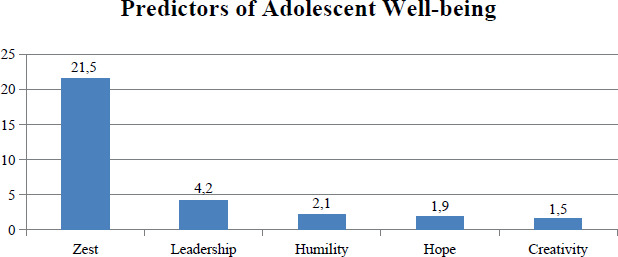
The second objective was to identify the predictors of well-being. As illustrated in Table 2, a comprehensive analysis of the data reveals that five distinct character strengths – namely, zest, leadership, humility, hope, and creativity – have been identified as significant determinants of well-being. Zest was identified as the primary predictor of well-being, contributing to 21% of the variance in outcomes. As illustrated in Table 2, there is a positive correlation between the strength of zest and the well-being of adolescents. The second most significant predictor of the well-being of adolescents was identified as leadership strength, with an individual contribution of 4%. According to the findings of the data analysis (B .221), the strength of leadership exerts a positive influence on the well-being of adolescents. A recent study has identified humility as the third most significant predictor of adolescents’ well-being. The data analysis (B -.153) indicates that high humility has a detrimental effect on the well-being of adolescents. The present study demonstrated that hope was the fourth most significant predictor of the well-being of adolescents. The findings of the present study indicate that optimism exerts a beneficial effect on the well-being of adolescents. The present study identified creativity strength as the fifth and final significant predictor of adolescents’ well-being. The present study sought to examine the relationship between creativity and well-being in adolescents. The findings indicated that creativity has a negative effect on the well-being of adolescents. The findings of the study indicate that zest, leadership, humility, hope, and creativity collectively accounted for 31.5% of the observed variance in well-being in adolescents. The findings indicated that creativity has a negative effect on the well-being of adolescents. The findings of the study indicate that zest, leadership, humility, hope, and creativity collectively accounted for 31.5% of the observed variance in well-being.
Discussion
The objective of the present study was to ascertain the character strengths of adolescents that are associated with their well-being and to identify those that predict well-being. Consequently, the data underwent scrutiny through the implementation of Pearson correlation and stepwise regression analysis. The results obtained from Pearson correlation analysis demonstrate that, among the 24 character strengths, 10 (Zest, Love, Curiosity, Citizenship, Self-Regulation, Leadership, Hope, Gratitude, Humor, and Spirituality) exhibit a high correlation, 9 (Judgment, Love of Learning, Perspective, Persistence, Social Intelligence, Forgiveness, Bravery, Fairness, and Appreciation of Beauty) demonstrate a moderate correlation, and 5 (Prudence, Kindness, Honesty, Creativity, and Humility) demonstrate a weak association with well-being. The findings of this study suggest a positive correlation between all character strengths and adolescent well-being. A positive correlation has been demonstrated between overall character strengths and composite scores of overall well-being (PERMA + Happiness). According to Wagner et al. (2019), character strengths contribute significantly to well-being and offer insights for focused strength-based interventions. These researchers support the notion that different character strengths play roles in predicting PERMA aspects. Pandey, Singh (2024) conducted a study on school students and found that character strengths and resilience have a positive relationship with well-being. Vohra and Pandey’s (2020) study identified a set of 12 character strengths that are associated with mental health. A positive correlation was identified between character strengths and overall subjective well-being.
The findings from the regression analysis indicated that character strengths have a substantial impact on the prediction of adolescents’ well-being. A study was conducted to identify the factors contributing to adolescents’ well-being. The analysis yielded five key predictors: zest, leadership, humility, hope, and creativity. A recent study has demonstrated that zest, leadership, and hope are positively correlated with overall well-being. This suggests that individuals who possess a stronger inclination towards these qualities may also experience enhanced well-being. Botha’s (2020) study yielded a statistically significant association between character strengths and well-being. The researchers demonstrated that the strengths of gratitude, curiosity, zest, and hope were the most significant indicators of the resilience and well-being of AEPs (accomplishment of expatriate partners) and that they also exhibited a positive correlation with the resilience and well-being of participants. Concurrently, two character strengths (humility and creativity) were identified as negative predictors, suggesting that an elevated level of these qualities may adversely impact well-being. The present findings stand in contradistinction to those of earlier studies. Conversely, elevated humility and creativity have been demonstrated to exert a detrimental influence on well-being. In sum, the variable of “character strengths” accounted for approximately 31.5% of the total variance in the subject group’s well-being.
Conclusion
The findings of the study indicate a significant correlation between character strengths and well-being, with certain prominent strengths emerging as predictors of adolescent well-being. The present study found that zest, leadership, and hope were positive predictors of adolescent well-being. Conversely, humility and creativity were found to be negative predictors.
The following section will delineate the implications of the study.
Character strengths have been identified as pivotal elements that facilitate positive engagement and enable individuals to overcome adversity, thereby promoting well-being.
The integration of character strength education into the curriculum has the potential to positively impact students’ academic and personal growth.
Students who exhibit high character tend to demonstrate superior academic and professional performance. In addition, they frequently exhibit higher levels of well-being, characterized by enhanced mental health, increased satisfaction with life, and stronger social integration.
Character strengths have been identified as the essential components that enable individuals to maintain a positive outlook and effectively overcome adversity.
The following section will address the limitations of the study.
The data were collected using self-report questionnaires, which may have been influenced by factors such as false self-perceptions or social desirability.
The relevance of the study’s findings to more extensive or heterogeneous populations may be constrained due to its narrow focus on a relatively small group of adolescents.