

Introduction
India is standing fourth largest economy in the world followed by USA, China, and Germany. After independence, Government of India has putted several efforts to resolve the challenges of food security and hunger. In food grains, India has accomplished self-sufficiency and has a large stock of grains (Upadhyay, Palanivel, 2011; GoH, 2022a). However, the mere availability of food grains is insufficient; their access to all people and sustainability is necessary for food security. Due to the lack of proper allocation of resources, hunger persists, uneven distribution of resources, and various geographical and economic disparities among the States, the country is in front of a significant challenge in reference to nourishment security. Numerous actions have been commenced to guarantee food security at reasonably priced for families living BPL. One such measure is the Public Distribution System (PDS).
In the economy of India, the PDS measure witnessed as an everlasting feature. This is a food security system run by the GOI under the Ministry of Consumer Affairs, Food, and Public Distribution (MCAFPD). Essential items including rice, wheat, sugar and kerosene are distributed through a systematic chain system of FPS under PDS. It is implemented in all regions of India. In Haryana, the Department of Food supply and PDS is the central agency that is accountable for the implementation and regulation of all the policies of PDS in the State. Since the time of formation of Haryana state, PDS was not as comprehensive as today. With time, the coverage area and size under this program have been increasing day by day, and the state government has also been implementing transformations in PDS periodically. National food security Act 2013 had been launched by State government of Haryana first w.e.f. August 20, 2013. The State is employing this scheme of “End-to-End mechanization” of TPDS operations for online supply chain management, ration card management, allocation and ration supply through an Aadhar-enabled public distribution system. Online grievance redressal facility is being provided by the authorities of state government. “At present, 9344 fair price shops and 2697460 ration cards are covered by e-PDS in Haryana” (GoH, 2022b).
The PDS is not a new scheme that has been launched in India. It was first introduced in the Second World War in 1940 as a “rationing measure” and was launched in its current form in 1947. Further, the PDS was systematized during the period of the India-China and India-Pak wars when India was facing drought and severe food shortages. Up to the mid-sixties, the rationing system depended on imports due to the shortage of food grains production in India (GoI, 2022a).
To overcome the food scarcity situation, India systematized the PDS by introducing the green revolution in India with the help of agriculture scientists. Various measures were taken to increase domestic food production to strengthen the public distribution system and reduce the country’s import dependence. In 1965, the Agriculture Price Commission and Food Corporation of India (FCI) were set up to provide minimum support prices for selected crops and to improve domestic procurement and storage of food grains for PDS. With time, several major reforms were carried out by the government in the PDS.
Characteristics of the Fair Price Shops (FPS), Antyodaya Anna Yojana (AAY), Below Poverty Line Beneficiaries (BPL) and Other Preferred Households (OPH)
Fair Price Shop is a shop that has been provided with a license by the Food and Supply Department to distribute commodities to the beneficiaries through the public distribution system (GoH, 2022a). Fair Price Shop owner means a person, any cooperative society, a corporation, or any other body in whose name a shop has been licensed to distribute essential commodities through the public distribution system (GoH, 2022a). The FPS must follow the rules of the National Food Security Act, India. After the digitization of the PDS system, all the stocks and sale records are digitally regulated in India.
The Antyodaya Anna Yojana (AAY) was launched in 2000 to make the TPDS more focused and target-oriented towards the poorest of the poor. Under this scheme, the provision was made to provide food grains at a highly subsidized rate of 2 rupees per kg for wheat and 3 rupees per kg for rice to one crore poorest of the poor families covered under the TPDS. Initially, there was a provision to provide 25 kg per family monthly to one crore poorest of the poor families identified among the BPL families. The entitlement was increased from 25 to 35 kg per family per month in April 2002.
The Scheme of the BPL and OPH beneficiaries was introduced under the Nation Food Security Act (NFSA), 2013. Under this programme, the BPL beneficiaries are provided 5 kg wheat per person per month and 1 kg sugar per family on monthly basis. In Haryana the families with annual income up to rupees 1.80 lakh are eligible for the BPL category. The families whose income is above the BPL but still low are covered under Other Preferred holders and provided 5 kg wheat per person per month under NFSA priority households.
Major social issues in Mewat district in Haryana, India is reported such as low education level & literacy rate (36%), Gender Inequality and Women’s Health related problems, lack of Healthcare Infrastructure, poverty & limited economic opportunities, social & cultural barriers and crime, drugs & cybercrime.
Study area
The district of Mewat is purposively selected for the present study. It is the most backward district of Haryana, especially in terms of the living standard of people, education, and health indices. The community has the first rank in having the percentage of the population who are multidimensionally poor. The Head Count Ratio of the district is 63.18% (Niti Ayog Report on Haryana: National Multidimensional Poverty Index). As per the 2011 census, most of the population in Mewat (88.61%) reside in rural. The huge proportion of the rural population of Mewat district has getting benefits of the PDS in the State. Mewat district has achieved second rank in the State in the scope of Below Poverty Line (BPL) beneficiaries and Other Preferred Holders (OPH) beneficiaries in the proportion of the rural population (GoH, 2022b). The district is divided into five blocks: Firzepur Jhirka, Nuh, Pinagwan, Punhana, and Taoru.
Methodology
The study is based only on secondary data which is collected from several government reports such as Food and Supply Department, Haryana, Census of India Report, PDS Portal of Haryana, Economic Survey of Haryana, Economic Survey India, and Multidimensional Index Report of India. FPS ratio is the arithmetic mean of BPL, AAY, and OPH cardholders to the percentage of FPS in the study areas. It is used in the study to check the coverage of RCH under the FPS in Mewat. The analysis was conducted by using descriptive statistics.
Review of literature
Anuradha (2015) evaluated the “coverage area under the Universal public distribution (UDS) system in Tamilnadu and compared it with the PDS of India”. The result of the study revealed that the scope of UDS in Tamilnadu is much better as compared to the PDS in other states of the country. The UDS in Tamilnadu delivers food grains to a large section of people than the other states of India Kavita (2014) evaluated the of take of total foodgrains and its share with the population under PDS in various states in India during 2011-2012. Khera and Somanchi (2020) tried to “estimate the coverage of the public distribution system in India”. The study found that 75% of the rural and 50% of urban population shall be covered under the assistances of PDS in India as per the norms of the National Food Security Act (NFSA), 2001. The study accounted that as per the requirement of Act in place 922 million people, PDS covers 809 million people (based on population projection 2020) in India. The study retrieved state-wise coverage of PDS in India and results revealed that 24.9 million people are covered under PDS in Haryana state against the requirement of 28.8 million people.
Jaybhaye et al. (2021) highlighted the dispersion and coverage of PDS using the arithmetic mean of the percentage of ration card holders under the categories of BPL, AAY and APL to the percentage of FPS in the study area. Significant differences in the district’s PDS coverage and penetration were shown by the study.
Swaminathan (2008) attempted to highlight the deterioration of the scope of the poor and food-insecure people of India from the benefits of PDS after implementing the Targeted Public Distribution System (TPDS) in the country. Based on the evidence from government reports like the NSSO report 2007, the study tried to illustrate the magnitude and nature of the exclusion of people from PDS. The study’s results revealed that 70.5% of rural households, 52% of agriculture labour households, and more than 20% landless & near landless people of India and a significant proportion of people living BPL are excluded from PDS.
In the background of the research, as mentioned earlier, the current study, therefore, is an attempt to highlight the extent of the success of the PDS system by assessing the success aspect of the scope in the Mewat district of the State.
Results and discussion
The ratio of the beneficiaries under the categories of BPL, APL, AAY, and OPH in Mewat
In Haryana, Mewat is the district where greater than 85% population fall under the PDS, and as mentioned earlier, greater than 88% of household reside in rural. It is the least developed district of the State, and the highest ratio of the population comes under the category of OPH and BPL, respectively. The proportion of AAY beneficiaries is 8.33 in the district. The Mewat district has a small number of beneficiaries in the APL category. While in another district, the percentage of APL beneficiaries is very high in comparison to other categories of PDS. The ratio of different categories of PDS in the district is shown in the figure below.
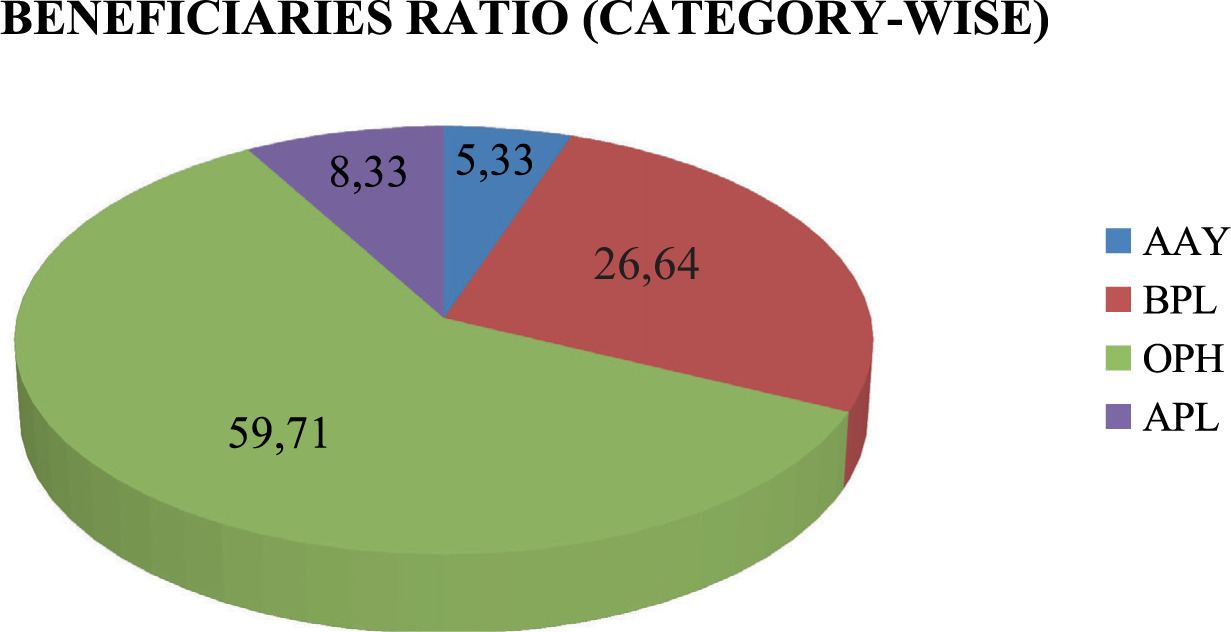
The ratio of the beneficiaries under AAY in Mewat (block-wise)
The BPL and AAY are the priority beneficiaries of the PDS in India. As discussed earlier, the ratio of AAY beneficiaries in the district is low. Punhana block has the highest share of AAY beneficiaries (6.76), followed by Firzepur Jhirka (6.64) and Pinagwan (6.47). The blocks of Taoru and Nuh have the lowest share of AAY beneficiaries in the district. The primary reason behind it is that Nuh and Taoru blocks are more economically developed than the other blocks in Mewat. The block-wise ratio of AAY in the district is shown in table 1.
Table 1
The ratio of AAY beneficiaries in Mewat (block-wise) as of February 2022
[i] Source: GoH, 2022a.
The ratio of the beneficiaries under BPL in Mewat (block-wise)
Regarding the rural population covered under BPL, Mewat has the second rank in the State (PDS Portal, Haryana). As shown in table 2, the highest ratio of BPL beneficiaries belonging to Punhana block, followed by Firzepur Jhirka, Pinagwan, which is the most backward block of the district. Whereas, Taoru has the lowest rank in the ratio of beneficiaries falling below the poverty line, followed by Nuh.
Table 2
The ratio of BPL beneficiaries in Mewat (block-wise) as of February 2022
[i] Source: GoH, 2022a.
The ratio of the beneficiaries under OPH in Mewat (block-wise)
As discussed earlier, Mewat has the second rank in Haryana in having the most significant proportion of the rural population under the other preferred holder’s category. Taoru block has the highest ratio of OPH beneficiaries, followed by Firzepur Jhirka and Nuh. At the same time, Punhana has the lowest proportion of OPH beneficiaries in the district, followed by Pinagwan block. The ratio of the beneficiaries under the OPH category (block-wise) is shown in table 3.
Table 3
The ratio of OPH Beneficiaries in Mewat District (block-wise) as of February 2022
[i] Source: GoH, 2022a.
The ratio of the beneficiaries under APL in Mewat (block-wise)
The APL beneficiaries were excluded from the benefits of the PDS after the execution of the National Food Security Act, (NFSA), 2013. Under this category, the cardholders don’t get any benefits from Public Distribution System. As Mewat is the most backward district of Haryana, the number of APL category households in the district is the lowest in Haryana (GoH, 2022a). As shown in table 4, Punhana has the highest ratio of APL category beneficiaries, followed by the blocks of Pinagwan and Nuh. The lowest proportion of APL beneficiaries is in Taoru, followed by Firzepur Jhirka and Nuh.
Table 4
The ratio of APL Beneficiaries in Mewat District (block-wise) as of February 2022
[i] Source: GoH, 2022a.
Fair Price Ratio in Mewat (block-wise)
As per the guidelines of the central government, one FPS is usually allotted 400 ration cards (Jaybhaye et al., 2021). There is an inverse relationship between NFSA beneficiaries and FPS Ratio. The highest FPS ratio indicates the increased burden of beneficiaries on FPS and vice-versa. As shown in table 5, all the blocks in Mewat fall under the ideal criteria of FPS ratio, and so the results of the FPS ratio are highly satisfactory.
Table 5
FPS Ratio in Mewat (block-wise) as of February 2022
| Sr. no. | Name of Blocks | No. of FPS | No. of ration card under NFSA | FPS Ratio |
|---|---|---|---|---|
| 1 | Firzepur Jhirka | 146 | 38706 | 265 |
| 2 | Nuh | 144 | 35568 | 247 |
| 3 | Pinagwan | 65 | 19139 | 294 |
| 4 | Punhana | 119 | 36471 | 306 |
| 5 | Taoru | 59 | 18558 | 314 |
| Total | 533 | 148442 | 278 |
[i] Source: GoH, 2022a.
Ration Distribution per cardholder through PDS in Mewat
Table 6 shows the details of the block-wise sale of ration distribution per cardholder in the district. The commodities: Sugar and wheat are distributed in the district through PDS to cardholders. The AAY and BPL cardholders are provided Wheat and sugar per month through PDS, and the OPH cardholders are provided only Wheat through the PDS system in the district of Mewat. The monthly sale of Wheat and sugar (per cardholder) in Mewat is 28.859 kg and 0.858 kg, respectively. The highest sale of both commodities was recorded in the Taoru block of the district, and the lowest sale of Wheat and sugar was recorded in Nuh and Firzepur Jhirka, respectively. The satisfactory results are seen in the whole district. The sale of both commodities to ration card holders is very close to the full entitlement of ration, which should be taken by the card holders.
Table 6
Distribution of ration through PDS per cardholder in Mewat (block-wise) in kg January-September 2022
[i] Source: GoH, 2022a.
Performance of PDS in Mewat (block-wise)
The performance of each block in Mewat in PDS coverage is shown in table 7. Rank is given to all blocks of Mewat to check the performance of PDS in terms of the coverage of FPS and the sale of Wheat and sugar to the beneficiaries. As the table depicts that Taoru block has top rank in the scope of FPS and sale of both commodities: Wheat and sugar. The position of other blocks is not equal in the coverage of FPS and the sale of Wheat and sugar. It is the Nuh block that has the lowest rank in terms of the FPS ratio and per month sale of Wheat to the beneficiaries. The Firzepur Jhirka blocks have the most down position in the sale of sugar to beneficiaries.
Conclusions
Nearly 85% population in Mewat depend on the PDS to fulfil their meal requirement. Observations based on the discussions with the beneficiaries in the district highlighted the issue of exclusion in the case of the AAY category. Several families are eligible for the AAY category but have BPL cards, and many ineligible cardholders have fallen into the BPL category. PDS provides the most significant outreach to OPH beneficiaries in the district. It is the Taoru district that has a higher ratio of OPH beneficiaries. The share of APL category households is meager in the district. There are no significant disparities in the blocks based on the coverage of the FPS ratio and sale of Wheat and sugar. The results regarding the outreach of PDS in the district are satisfactory. There is a need to pay attention to the inclusion and exclusion errors in the district, and the criteria for identifying the beneficiaries should be updated.