

Introduction
University can be a critical time for self-discovery and social development. However, for many young adults, this period can also be fraught with anxieties surrounding body image. In most recent news, we come across headlines which states that body image issues and stigmatization affect students in their various universities. On the other hand, it is no longer a news on how students commit suicide because of stigmatization and body image dissatisfaction. The students of Enugu State University of Science and Technology are not left out in this regard. Considering the social and academic pressures that undergraduates typically face, it is reasonable to believe that students from the above-mentioned university may be particularly vulnerable to the negative effects of stigma and body image issues.
At this point, we need to ask an important question. What is Stigma? Stigma is typically explained as a mark of shame, a sense of shame. Stigma from the Latin, first referred to the mark made on the skin by burning with a hot iron to indicate a low social status. Later, the term came to be used as a metaphor for physical defects or a mark of disgrace. This significance of stigma is undoubtedly negative, representing a range of attributes that should be rejected by the society, such as shame and humiliation. In a given society context, a person with such attributes is often supposed to be reduced to a flawed, despised person (Wang, 2022).
Goffman in the field of psychology defined stigma as an attribute, behaviour, or reputation that is socially discrediting in a particular way. It causes an individual to be mentally classified by others in an undesirable, rejected stereotype rather than in an accepted, normal stereotype. Stigma represents a deeply humiliating characteristic or attribute, not only as a derogatory and insulting symbol and label for these individuals and marginalized group in the society but also a representation of a defect such as a physical disability or even a stain on an individual’s character qualities or as an unpopular marginalized class or membership of a group that is different from the dominant group in the society (Goffman, 1963).
There are different types of stigmas but in this article, we will limit ourselves to four types namely; public stigma, self-stigma, perceived stigma and label avoidance. Public stigma is the perception held by a group or society that an individual is socially unacceptable and often results in negative reactions towards the said individuals. Self-stigma is the perception held by an individual that she or he is socially unacceptable. Here, the individual internalizes public stigma (Krenawi, 2024). Perceived stigma is the stigma that people with (potentially) stigmatized mental health condition fear or perceive to be present in the community (Fiorillo et al., 2016). Label avoidance refers to attempt by one to avoid having a diagnostic label attached or implied in order to prevent having stereotypes applied to the self. It is dodging the group altogether in order to escape the negative effects of public and self-stigma (Maddux & Tangney, 2010).
Stigmatization of people has persisted throughout history. It is manifested by bias, distrust, stereotyping, fear, embarrassment, anger, and or avoidance. Stigma leads to avoiding living, socializing and working, renting to, or employing a certain group of people. Stigma reduces ones’ access to resources and opportunities (e.g. housing and jobs) and leads to low self-esteem, isolation and hopelessness. More tragically, it deprives people of their dignity and interferes with their full participation in society (Ciment, 2006). Even in the academic environment, some students experience stigma because of the shape or colour of their body. Some face stigma because of their poor performance, coming from poor family, living in a poor environment, etc. The psychological impact of stigma can be significant. Students who are stigmatized because of body shape and weight tend to experience heightened anxiety, depression, and diminished self-worth because of the negative societal attitudes they encounter (Carotenuto, 2024).
The above point sustains that there is a connection between stigma and body image dissatisfaction. In the contemporary society, appearance in general and body image have become central and important concepts. The strong emphasis on appearance is very much evident when media images are perused, shop windows are looked at, magazines flicked through and websites visited. The body image is associated with the mental representation or perception that we create of what we think it is we look alike; it can or may not bear a close relation to how others really see us; this may be very different from a person’s actual physical appearance (Peate & Glencross, 2015). In addition, body image is not only the way people perceive themselves but, equally important, the way that others see them (Osuji & Kramer-Kile, 2014). Furthermore, some body image is a multi-faceted construct that represents a person’s inside view of his/her body, that is his/her feelings, perceptions, and thoughts about his/her body, which collectively impact how he/she behaves toward it (Nagata et al., 2021).
Body image dissatisfaction is a common psychological problem which refers to the negative subjective evaluation of one’s physical body, such as figure, weight, stomach and hips. However, we should note that body image dissatisfaction should be differentiated from the overemphasis placed on weight and shape in determining self-worth, which is a symptom of both anorexia and bulimia nervosa (Robert-McComb et al., 2008). There are several factors which can influence body dissatisfaction. Take for instance, friends, family members, relatives, teachers, print media (newspapers, magazines and books) and electronic media (radio, television and internet) all have an impact on how a person sees, feels about his or her appearance. Body Image dissatisfaction could also be viewed as thoughts, feelings and behaviours, formed from developmental/social experiences that intensify preoccupations with real or imagined defects in physical appearance (Agbu, 2011).
Dissatisfaction with body image could lead to intense preoccupation with a perceived flaw in physical appearance. In this regard, students concerned often spend significant periods of time worrying about and evaluating a particular aspect of their appearance. Large amounts of time may be spent checking the appearance with others, and engaging in behaviours designed to hide or conceal the area of concern. In addition, students that are dissatisfied with their body tend to be concerned that their body part is too big or too small, not the right shape, asymmetrical, or out of proportion to the rest of their body (Agbu, 2018).
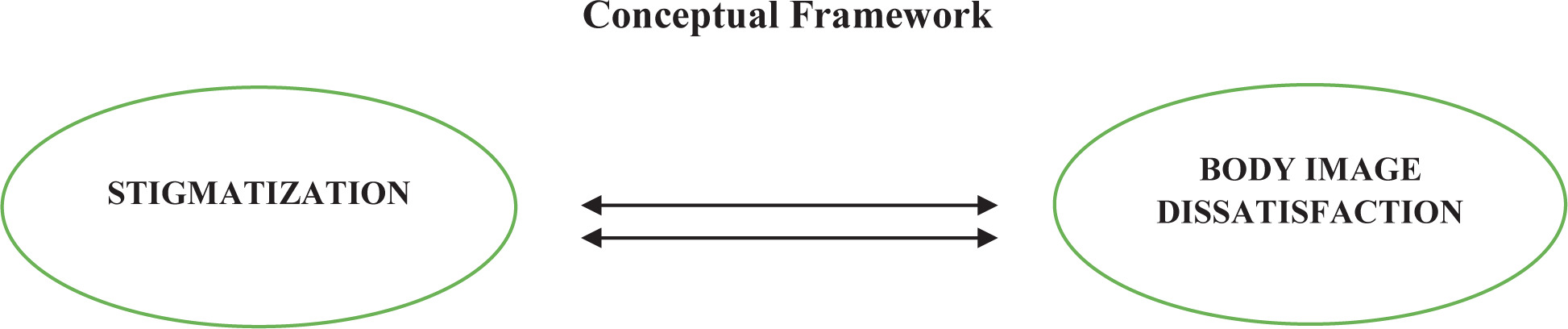
At this point, one will understand that there seems to be a relationship between body image dissatisfaction and stigmatization. Stigma can also have an indirect effect on body image dissatisfaction by influencing how individuals interpret social cues and messages. For example, an ESUT student who is aware of the prevalence of weight stigma on campus may become hypervigilant to social interactions, interpreting even neutral comments about weight or body size as criticism. This heightened sensitivity can lead to a distorted view of their body and increased body image concerns. Again, an ESUT student who avoids social gatherings due to fear of being teased about their weight is exhibiting a behavioral consequence of both weight stigma and body image dissatisfaction.
The novel insight in this study is to make students see the relationship between the two variables (body image dissatisfaction and stigmatization.), the ugly consequences it has on the students and to remember that intense preoccupation with real or imagined defects in physical appearance could lead to a psychopathological condition known as Body Dysmorphic Disorder (BDD), a disorder of imaged ugliness (APA, 2013). The antidote to body dissatisfaction is body acceptance. Body acceptance refers to the approval of, and caring for one’s body despite its real or received imperfections. This is inclusive of other terms like body positive, body neutrality and size acceptance. Being body positive or working towards body acceptance, does not mean that an individual absolutely love the way he or she looks all the time. It simply means acceptance of all bodies as good and worthy of care and respect. It also means that individuals are willing to confront internalized weight bias, and challenge other stereotypes or assumptions based on perceived appearance (Agbu, 2011).
Purpose of Study
Body image dissatisfaction cuts across all cultures. In fact, body image issues affect people of all ages, genders and across all cultures. Like we earlier stated, what we understand by body-image is complex and multidimensional. It is not only the picture of our own body that we form in our own mind, but also the way that we feel about ourselves (Ugwuanyi and Formella, 2023). Many students are subjected to widespread stigma and discrimination across educational and interpersonal settings. There are some students who are thin or fat and they are more likely to be stigmatized or teased for their weight (Cash, 2012).
This research aims to study the potential impact of stigma on body image dissatisfaction and the precise relationship between stigma experiences and body image dissatisfaction among Enugu State University of Science and Technology (ESUT). Therefore, investigating the nuanced interplay between stigmatization and body image dissatisfaction among undergraduate students of ESUT. It is imperative to create awareness on this and to inform students effective strategies for promoting a supportive and inclusive campus environment conducive for optimal mental health outcomes.
Literature Review
Numerous studies have shown interests in our variables of study but we will like to limit ourselves to two theories namely attribution theory and social comparison theory.
Attribution theory is a major area within social cognition that explores how people explain the causes of behaviour. When we observe someone’s actions, we often strive to determine whether their behaviour is due to internal factors (Such as personality or intentions) or external factors (such as situations or environment). This process of attributions can influence how we react to others and how we perceive their actions. For example, if someone cuts off in traffic, we might attribute their action or behaviour to them being rude or careless person (internal attribution). Alternatively, we might consider external factors, such as the possibility that they are rushing to an emergency (Vanamali, 2024). By understanding the attributional processes and biases, researchers can gain insights into how stigmatization may be attributed to internal or external causes, and how these attributions may impact health-seeking behavior among undergraduate students.
Social comparison theory was proposed by Leon Festinger. He theorized that humans have an innate tendency to derive information regarding the self through the process of social comparison (Festinger, 1954). Festinger thought that people best serve this need for self-evaluation by measuring their attributes against direct, physical standards. When objective standards are unavailable, however, individuals compare themselves with other people. The central proposition of Festinger’s theory is the “similarity hypothesis,” which predicts that individuals prefer to compare themselves with similar others (Wood, 1989). In relation to undergraduate students’ body dissatisfaction, this theory postulates that constant exposure to ideal students’ bodies in traditional and social media results in a greater frequency of upward comparisons to bodies that are largely unrealistic and unobtainable.
Participants
One hundred and eighty-five (185) undergraduate students participated in this study. The participants comprise of 72 male and 113 female students. The participants were drawn from a selected institution, which is Enugu State University of Science and Technology (ESUT), Enugu State. The Participants were gotten from different departments in the institution using purposive sampling techniques (25 from Psychology, 21 from Sociology, 21 from Law, 26 from Geology and mining, 23 from Engineering, 30 from Political Science and 39 from food and science technology). The researchers use their judgment to choose departments who can best provide rich, detailed information about their research. The department were selected non randomly which is a key characteristic in purposive sampling techniques. Participants are chosen deliberately based on the fact that they could answer the questions. Age range of the participant selected was from 19-26 years and a mean age of 22.31, with a standard deviation of 2.91. Demographic variables such as age, gender and departments were examined.
Instruments
Two instruments were used to gather information in this study. They include; Stigma Scale (Link, Yang, Phelan and Collins, (2001) And body shape questionnaire (Cooper, Taylor, Cooper & Fairburn, 1987).
Procedure
A total of two hundred (200) copies of the questionnaires on social media scale and body image scale were randomly distributed within a period of two (2) weeks on the target population. One hundred and eighty-five (185) were correctly filled, scored, analyzed and the remaining 15 copies of each questionnaire were discarded due to incomplete filling of the items in the questionnaire. The administration of the questionnaires took the form of individual testing in their respective classes. Participants who accepted to be a part of the study were advised to take their time in filling out copies of the questionnaire since any improper filling invalidates the instrument. They were also informed that participation is voluntary and are free to withdraw in case the need arises.
Design and Statistics
The design adopted for this study is correlation design, while Pearson product moment correlation statistics was used in analyzing the data gotten by using statistical package for Social Sciences (SPSS) software (Version 26).
Result
Table 1
Correlations of demographic variables, stigmatization and body image dissatisfaction
| S/N | Variable | M | SD | 1 | 2 | 3 | 4 |
|---|---|---|---|---|---|---|---|
| 1 | Gender | 1.53 | .50 | - | |||
| 2 | Age | 22.31 | 2.91 | .13** | - | ||
| 3 | Stigmatization | 13.23 | 4.97 | .14** | .09** | - | |
| 4 | Body Image Dissatisfaction | 10.44 | 14.68 | .37*** | -.17** | .27*** | - |
Results in Table 1 shows that body image dissatisfaction was positively significantly related to gender (r = .37, p< .001), and stigmatization (r = .27, p< .01); and negatively significantly related to age (r = -.17, p< .01). Thus, the finding implies that both male and female are faced with body image dissatisfaction. Increases in stigmatization among undergraduates increases body image dissatisfaction. Gender has positive significant relationship with age (r = .13, p< .01), and stigmatization (r = .14, p< .01). Age has positive significant relationship with (r = .09, p< .01).
Table 2
Hierarchical multiple regression predicting body image dissatisfaction from stigmatization
| R | R2 | R2Δ | B | Beta(β) | T | |
|---|---|---|---|---|---|---|
| Step 1 | .32** | .04** | .10** | |||
| Gender | .09 | .32** | 5.21 | |||
| Age | -.07 | -.02* | -.19 | |||
| Step 2 | ||||||
| Stigmatization | .37*** | .13*** | .09*** | .55 | .09*** | 1.50 |
The results of the Hierarchical Multiple Regression in Table 2 above indicates that the demographics, gender (β = .32, p< .01), and age (β = -.02, p< .05) were significant predictors of body image dissatisfaction among undergraduates. The demographic variables accounted for significant 4% relationship with body image dissatisfaction (R2 = .04, p< .01). Stigmatization (β = .09, p< .001) is a significant positive predictor of body image dissatisfaction among undergraduates. It accounted for significant 9% variance in predicting body image dissatisfaction (∆R2 = .09, p< .001).
Summary and findings of the study
1) Body image dissatisfaction was positively significantly related to gender, and stigmatization; and negatively significantly related to age.
2) Gender and age significantly predicted body image dissatisfaction.
3) Stigmatization is a significant positive predictor of body image dissatisfaction among undergraduates.
This study examined relationship between stigmatization and body image dissatisfaction among Enugu state University of Science and Technology undergraduates. The finding of the study showed that stigmatization was a positive significant predictor of body image dissatisfaction among undergraduates. Thus, the more an undergraduate is stigmatized, the more likely such an undergraduate will have body image dissatisfaction. The hypothesis that stigmatization will significantly correlate with body image dissatisfaction among ESUT undergraduates was accepted.
Implications of the Study
The findings of this have various important implications for practical, theoretical and empirical research.
Theoretically, the finding gives credence to the postulations of social identity theory, that individuals behavior is dependent on how well they identify with society and their perceptions of how other see them. We can put it in a better way by saying that social identity theory is based on the assumption that people categorize their social worlds, seeing themselves as members of ingroups and dissimilar others as members of outgroups. Maintaining this psychological differentiation fosters social comparison such that members of ingroups seek to see themselves as positively distinct from members of outgroups (Cupach & Spitzberg, 2011). In the university environment, students who feel that they have a perfect body tend to stigmatize those who tag that their body is imperfect.
Empirically, this study is in accordance with the investigation of some researchers who investigated the relationship between stigmatization and body image dissatisfaction. For example, Cash & Smolak (2012), the findings of their research stated that stigmatization experience remains strongly correlated with body image dissatisfaction. They reiterated that greater weight stigmatization has also been shown to correlate with more body image dissatisfaction among overweight men and women. However, undergraduates are online most of the time either for assignments or personal use. In fact, the advent of social media has brought a craze for body modification and the need to feel among; caused by a discontent with current body states, especially among the undergraduate students. This calls for urgent attention to reorientation of the youth on the inherent risks involved in use of social media. Social media can contribute to how people rate their bodies and stigmatize one another (Nnamchi et al., 2024).
The results of this study have some practical implications especially on how young people as undergraduates are deeply concerned about their body image dissatisfaction. Consequently, most undergraduate students worry about their physical appearance, their body image. Most of them are preoccupied by how others perceive or see them. Some are unhappy with their body image (Strom & Strom, 2021). It is important to note that stigma and body image dissatisfaction have a lot of negative effects on the undergraduates’ students. It includes the following: depression, anxiety, lower self-esteem and quality of life, poor academic performance, withdrawal, heightened stress, and higher binge eating, etc. To this effect, psychologists, parents and educators should constantly encourage their students and children to avoid stigmatization and focus on their self-worth other than people’s perception of them.
Limitations of the study
Some obstacles were encountered in the course of this study which include the unwillingness of the target population in participation of this research because of their busy academic schedules. Some of them were complaining that they have either lectures or quiz. Again, the sample size for this study was limited. Larger sample size may be necessary to allow for more generalization and possible conclusions. Another limitation is the choice of involving only undergraduates from one university. Although the study targeted at undergraduates as participants of interest for the study. However, it will be interesting to involve undergraduates of other institutions from other locations especially other regions of the country.
Suggestions for Further Studies
In view of these limitations given above, the researchers make the following suggestions for further or future research. The inclusion of larger sample size is necessary to give room for more generalization and conclusion. Samples sizes involving undergraduates of other geographical regions in Nigeria can be used for better generalization of findings.
Summary and Conclusion
Body image dissatisfaction and stigmatization are societal problems that requires urgent attention. This is because they pose a lot of challenges for the students. This study has shown that stigmatization especially in this present generation negatively impact the way undergraduate students perceive themselves. Body image dissatisfaction and stigmatization can trigger a cascade of negative psychological effects on the students but above all, families and the society at large will be affected if the causes are not resolved. Undergraduate students need to understand that in the world of today, there is a great deal of social pressure to be beautiful. On the other hand, people that deviate from the beauty standard are more likely to experience stigmatization and discrimination behaviour (Herndon, 2012).